Invoking the Essence of Landscape Through Digital Art
The profound tranquility of a misty forest, the raw power of a mountain range under a vast sky, or the delicate intricacy of a wildflower meadow—these scenes from the natural world evoke a universal sense of awe. In creative and commercial fields, capturing this essence is a constant pursuit. For designers, marketers, educators, and entrepreneurs, the challenge often lies not in the vision, but in the practical execution: acquiring high-quality, versatile visual assets that truly resonate. This is where specialized digital illustration collections enter the frame, serving as a bridge between inspiration and application.
The Core of a Purposeful Illustration Set
When evaluating graphic resources, the technical foundation is as critical as the artistic style. A collection built around themes like nature landscape offers more than just pretty pictures; it provides a functional toolkit. The inclusion of AI EPS file formats is a significant aspect of this utility. EPS, or Encapsulated PostScript, is a vector-based format. This means the illustrations are not composed of fixed pixels but of mathematical paths and points. The result is infinite scalability. An icon depicting a solitary pine tree can be enlarged to banner size or reduced to a button symbol without any loss of detail or clarity, a quality indispensable for maintaining visual integrity across diverse media.
Structural Integrity and User Accessibility
A thoughtfully organized file and layer structure transforms a collection from a simple download into a manageable project asset. For professionals working under tight deadlines, time spent searching for a specific element or deciphering a chaotic layer stack is time lost. Neat organization means that a river illustration might have separately grouped layers for water flow, riverbank foliage, and background hills, allowing for rapid customization. This consideration extends to platform compatibility. Resources designed for both Mac and Windows users eliminate a basic barrier to entry, ensuring that the tools are accessible regardless of the operating system preference of the designer or team.
Practical Applications in Real-World Contexts
The true value of any asset is measured by its applicability. The characteristics of a well-crafted, vector-based landscape illustration set open doors to a multitude of use cases. In the realm of print, the perfection in details and consistency ensures that brochure layouts, magazine features, or packaging designs present a sharp, professional image. For web and app development, the same files provide crisp, fast-loading interface elements, symbols for navigation, or thematic backgrounds that adapt to various screen resolutions seamlessly.
The educational sector finds potent use for such materials. Researchers illustrating ecological concepts, teachers creating engaging classroom materials, or hobbyists developing personal project blogs can all utilize these editable vectors to produce clear, accurate visual aids. Business owners, particularly in sectors connected to outdoor recreation, wellness, sustainability, or real estate, can integrate these nature-themed graphics into their branding, marketing campaigns, and internal documents to visually communicate their connection to environmental values or the serenity of natural spaces.
Adaptability as a Creative Engine
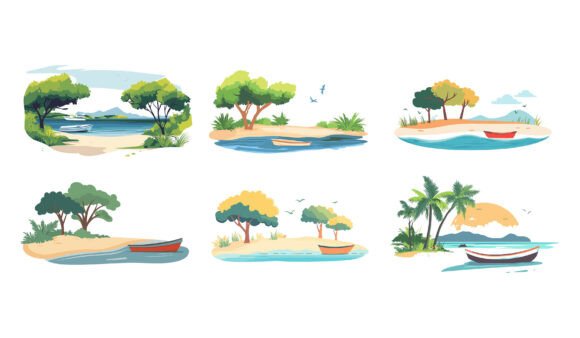
A defining advantage lies in the inherent adaptability of vector artwork. The ability to edit, change colors, and modify icons easily is not merely a feature; it is a creative catalyst. A default illustration of a mountain valley under a midday sun can be altered to reflect a dusk palette with deep blues and purples for a nocturnal brand theme, or the greenery can be adjusted to autumn hues for a seasonal promotion. This level of modification allows a single collection to serve as the source for countless unique derivatives, enabling brands to maintain a cohesive visual language while tailoring assets to specific campaigns, cultural contexts, or evolving design trends.
Beyond the Single Use: Infographics and System Design
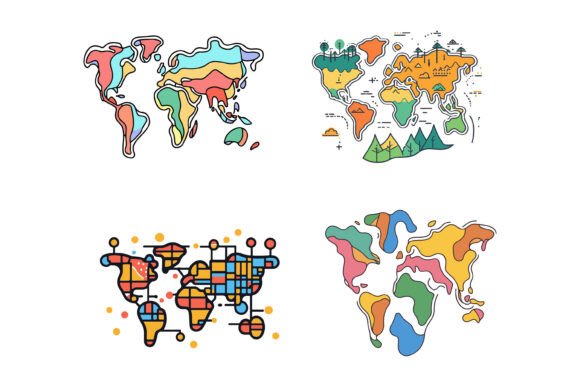
One of the more sophisticated applications is in the construction of infographics and symbolic systems. The clean, consistent details of a vector set make it ideal for building complex information graphics. Elements like trees, water bodies, rocks, and animals can be standardized and repeated to create maps, process diagrams, or data visualizations related to environmental science, travel, or resource management. Similarly, for app or platform design, these elements can become part of an icon library, where a stylized cliff face might represent a "difficulty" setting in a hiking app, or a flowing stream could symbolize a "refresh" function. This extrapolation from a literal landscape depiction to a metaphorical interface element demonstrates the deep utility of versatile artwork.
Considerations for users often revolve around workflow integration. The step from purchasing a resource to effectively employing it in a project should be fluid. A collection that emphasizes neat organization and easy editing directly addresses this. It respects the user's existing workflow, allowing them to focus on creative synthesis rather than technical troubleshooting. For teams, this consistency ensures that different members, from the art director to the junior designer, can work with the same files efficiently, producing outputs that are uniform in quality and style.
Observations on Quality and Consistency
In professional design, inconsistency is a common pitfall. Perfection in details across an entire collection means that every element shares the same artistic hand, the same line weight, the same stylistic treatment of light and shadow. This is not about rigid uniformity, but about harmonious cohesion. When creating a campaign that uses multiple natural elements—a logo with a tree, a website banner with a forest, and a printed guide with mountain icons—using assets from a cohesive set guarantees that these components feel like parts of a whole narrative, not disparate items cobbled together from different sources. This cohesion builds brand trust and enhances audience perception.
The Intersection of Art and Utility
The digital representation of nature and landscape is more than decoration; it is a communication tool. It can convey a brand's commitment to sustainability, illustrate a scientific principle, guide a user through an application, or simply create an atmosphere of calm on a website. The choice of foundational assets, therefore, carries weight. Opting for a resource that prioritizes both aesthetic fidelity to its natural themes and robust technical utility like scalable vectors, organized layers, and cross-platform compatibility is a decision that supports long-term creative and commercial goals. It provides a reliable, editable, and adaptable pool of visuals from which countless specific solutions can be drawn, enabling creators to translate the timeless inspiration of the outdoors into effective, modern digital expression.
Ultimately, the journey from a concept inspired by the physical world to a realized digital product involves many steps. Having a reliable, high-quality, and flexible set of illustrations at the core of that process removes significant friction. It allows the designer, educator, or business owner to invest their energy where it matters most: in messaging, in storytelling, and in crafting experiences that connect with their audience. The tools should empower, not hinder. When they do, the results can be as impactful and enduring as the landscapes they seek to evoke.